
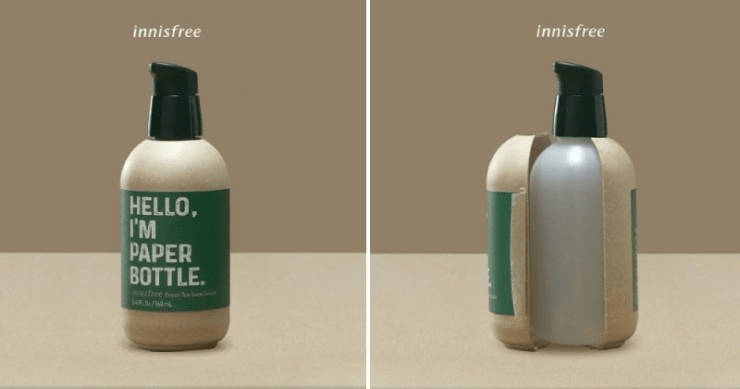
Image Credit : Captured from the Innisfree Homepage
The famous K-cosmetic brand recently experienced criticisms from the customers due to its fake packaging where plastic serum bottle being wrapped with paper being advertised as “Earth-friendly” product. Watching the news, unlike its fame of being one of the ‘Greeny brand,’ the bottle wrapped with paper outside a plastic seemed nonsense. Whether their true intention may have interpreted by the public, it’s that green marketing brands should take more responsibility and cautious when coming up with an environmentally friendly products.
Their ESG report(pg41) and the product explanation on the poster partly reveals that they may not intentionally created such type of packaging. Still, their miscommunication with the public brought them a need for the burden of proof and the negative associations that have been attached to the corporations were, to a certain extent, inevitable. In light of this, this post will examine the controversies surrounding Innisfree and explore how corporations should approach promoting their ESG (Environmental, Social, and Governance) efforts in the future.
What brought more customer discontent was what it said on the paper cover. It said “Hello, I’m paper bottle.” These words were enough for customers to feel that they were deceived or even humiliated by the brand when they found out the truth. However, this may seem a little too much for Innisfree because they stated on their ESG report and on the promotion poster that the product is with 51.8% decrease of plastic. It also added the guidelines for treating empty bottles. In their ESG report from 2020, it states as below.
“Innisfree used the bottle covered with paper for the green tea seed serum edition. This edition added both paper and lightweight plastic which is 51.8 percent decrease of plastic compared to the original serum bottle. Empty bottles can be separately discharged easily.
Also the cap used 10% of reused plastics and overall lessened the use of virgin plastic.”
How we view this incident depends on our personal values on environmental problems or personal image we already had toward the brand. What we as a customer to consider in priority is discovering what brand truly values. What other ESG activities did the brand been doing in the past few years? Are they using such bottle to lessen their cost spending on the packaging without any intention of producing environmentally friendly products? Is there a need for criticisms if they used such bottle to spend less on the packaging but eventually was better for the environment? The bottle happening left customers with lot to think of.
What I noticed from their ESG report is their progressive steps in creating sustainable packaging. Albeit the 10% of recycled plastic could be seen as a mere amount, lowering the use of virgin plastic was definitely a necessary step in creation of sustainable packages.
Hoffmann Neopac, constantly in development of sustainably designed packages, released a tube package with 30% less use of the virgin plastic. Reviewing the current packaging trends through the ESG report from Amcor Plc, a sustainable package corporation, using recycled materials and biomaterials for making packages to reduce the environmental wastes is one of an innovate approach as well as the lightweight packaging. If we compare their strategies to which Amorepacific utilized for their serum bottle, there are similar patterns found.
From the incident, it leaves public lessons that not only selling sustainable looking products is important, but adequate communication with the public about its product creation, and the awareness building process should be executed in order to minimize the risks. For my future posts, I will come up with other sustainable packaging strategies that are found to be innovative.
[Yeon Kim’s SDGs, ESG, CSR] [2023]. All rights reserved.
The content on this blog is the intellectual property of [Yeon Kim]. Unauthorized use and/or duplication of this material without express and written permission from this site’s author and/or owner is strictly prohibited. Excerpts and links may be used, provided that full and clear credit is given to [Yeon Kim] with appropriate and specific direction to the original content.


 Yeon joong kim's Website
Leave a comment